Category

writing

creativity planning & productivity writing

Gems #13 Time to write

January 30, 2011

I’m working on my annual review at present, reviewing 2010 and setting priorities for 2011. A consistent theme for me is about finding time to write. I work full-time in a very busy leadership role in the vocational education sector. I am passionate about my work and making a difference. At the same time, I am committed to creativity, writing and my personal goals. Making the time and space to write is a constant challenge.

Here are some gems I’ve come across recently, and in the past, about making time to write and basically getting on with it.

Anne Lamott’s article, Time Lost and Found, hit me pretty hard mainly because it rang so true. It’s about priorities in life, what matters and how we fritter away time and miss the important things. Her main message is that you need to make time for writing and other priorities and that this time can be found by having a good look at how you live. Twitter and other social media, television, cleaning, work and the gym are mentioned as areas where we might be losing time that we could allocate to our creative priorities such as writing. Anne says, in essence, that we do have this precious time and we can find it, though it might take some work to recover:

I’ve heard it said that every day you need half an hour of quiet time for yourself, or your Self, unless you’re incredibly busy and stressed, in which case you need an hour. I promise you, it is there. Fight tooth and nail to find time, to make it. It is our true wealth, this moment, this hour, this day.

An excellent article in last weekend’s Sydney Morning Herald Spectrum (January 22-23) by Australian author and teacher, Sue Woolfe, encourages us just to get on with it. Unfortunately, I couldn’t find the article online anywhere to link to but I can share the main points. Entitled,  ‘Don’t think about it – just keep scribbling’, Sue says that the way you need to work to write a novel is:

…to find a way of thinking that is mocked in our culture but that is all in the day’s work for artists, composers and writers.

This is a way based on discipline: reading fiction for an hour a day; writing for at least an hour a day; not rereading, editing or formulating and not sticking to a subject, character or plot when first writing. The whole focus is the discipline of writing and then later imposing other aspects such as narrative technique, plot structure and editing. In summary:

The whole endeavour is to lose self-consciousness.

However, it starts with those two fundamental ingredients: read fiction for an hour a day and write for at least an hour a day. Linking back to Anne Lamott’s article, the trick is to find this time by managing your priorities.

Some of my favourite practical articles on making time to write are by Australian blogger and author, Joanna Penn. Joanna lives and breathes this way of working and writing to come up with real outcomes such as completing her first novel, Pentecost and receiving a strong following and awards for her highly successful blog, The Creative Penn.

Joanna’s two posts: ‘On efficiency or how to get everything done as a multi-tasking writer,’ and ‘What will you give up to write your book?’ are perfect reads on the issue of writing and time and are grounded in practicality. Joanna’s tips include getting rid of the TV, sleeping less, maximising travel time, being organised and investing in education. Setting clear goals and priorities and ‘loving the process’ are also right up there as key motivators. 

As in Anne Lamott’s article, the emphasis is on the value of the outcomes spent on writing and other creative activities vs spending too much watching TV and engaging in an uncontrolled way with social media such as twitter. And as in Sue Woolfe’s article, the discipline to carry it all through is critical.

Now it’s back to my annual review with these valuable thoughts in mind. How are you making time to write this year?

Image, Time disappears by jtravism  from flickr and used under a Creative Commons license with thanks

Share

creativity planning & productivity writing

Planning for the Future Starts with Celebrating the Past

January 16, 2011

A guest post from author Sage Cohen

  A note from Terri:

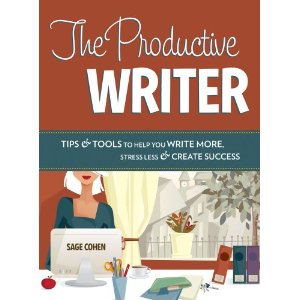
I am thrilled to have Sage Cohen, pictured left, writing here for my first guest post. Sage’s background and the details of her latest work, including her new book, ‘The Productive Writer‘ are below.  I am indebted to Sage and her work as a gifted writer and teacher who has enriched my writing life.

In this post, Sage encourages us to review our broader writing successes in 2010 in preparation for a productive 2011! 


Happy New Year, writers! I believe that there is no better launching pad into the great, blank page of 2011 than a thorough inventory of all that went right in 2010. With this in mind, I’m going to ask a series of questions to guide you in recounting your many successes this past year! I encourage you to take your time and be as thorough as you can in listing every single thing you appreciate about yourself and what you’ve accomplished in each dimension of your writing life–even if the best you can do is admire that you stopped burning your rejection letters. Deal?

  • What was most fun, exhilarating or rewarding in your writing life this year?
  • What obstacles did you face and overcome?
  • What relationships did you build, repair or retire, and how has this contributed to your writing life?
  • What did you let go of (habits, relationships, attitudes, clutter) that was no longer serving you?
  • What did you read that taught you something about your craft, your platform or how to take your writing and publishing forward?
  • What did you earn or what opportunity did you land that felt prosperous?
  • How has your confidence and/or craft improved?
  • What have you learned about social media that is serving your writing life?
  • What strategies worked best for being effective with your time?
  • How did you nurture and sustain your well being–in mind, body, spirit?
  • Who has praised your writing or teaching or facilitating? What did they say and how did it give you a new sense of appreciation for yourself and your work?
  • What did you learn about your writing rhythms: time of day to write, managing procrastination, how and when to revise, making use of slim margins of time, etc.?
  • Who did you help, and who helped you?
  • What did you learn about yourself from rejection, and how has it helped your writing, your confidence or your submissions approach develop?
  • What did you do that terrified you–but you did it any way? And how did that benefit your life and your writing?
  • How were you patient?
  • When and how were you successful at juggling the competing demands of family, writing, work, and everything else in your full life?
  • Who did you forgive? Who forgave you?

Because it’s so easy to keep our minds trained to the loop of an unsolvable problem or two, you may be surprised at how many triumphs are revealed as you answer these questions. Every risk you took, skill you fortified and skin you shed in the service of your writing life is a foothold in the future you are aspiring to create. Nice work!

 About Sage Cohen

Sage Cohen is the author of The Productive Writer (just released from Writer’s Digest Books);Writing the Life Poetic and the poetry collection Like the Heart, the World. She blogs about all that is possible in the writing life at pathofpossibility.com, where you can: Download a FREE “Productivity Power Tools” workbook companion to The Productive Writer. Get the FREE, 10-week email series, “10 Ways to Boost Writing Productivity” when you sign up to receive email updates. Sign up for the FREE, Writing the Life Poetic e-zine. Plus, check out the events page for the latest free teleclasses, scholarships and more.

Share

creativity planning & productivity transcending writing

Gems #12 Planning and Productivity

January 6, 2011


Happy New Year!

It’s great to be reading all my favourite blogging writers reflecting on 2010 and plans for 2011. It’s an exciting time for planning to be productive in whatever priority areas are critical for you. I thought I’d share some gems on planning and productivity that might be of interest for setting your agenda for 2011. They will certainly be part of my own personal planning.

Chris Guillebeau is something of a guru of personal planning. With a successful track record of setting and reviewing yearly goals, Chris shares his processes and goals with his readers generously. Chris has recently been working on his annual review of 2010 to inform planning for 2011. It starts with two simple questions:

What went well in 2010?

What did not go well in 2010?

From there, Chris reflects on 2010 and builds his plan for 2011, including setting the metrics for checking the achievement of his goals. I love his process and have found it personally rewarding over the last two years. Here are a couple of links to Chris’s recent writing on his annual review process:

2010 Annual Review – The Beginning

2010 Annual Review – Looking Forward

All of Chris’s recent posts on his annual review process are excellent and I will be revisiting them in full soon when I sit down to do my own reflection and planning process for 2011.

Charlie Gilkey has some excellent planning tools also at Productive Flourishing on his Free Planners page. There are all kinds of planning tools: ones for planning blog posts and daily, weekly and monthly action planners. There are also tools for identifying your most productive times. I will be looking to apply these in 2011. Highly recommended and again, shared generously which is appreciated.

In the writing field, Sage Cohen’s new book The Productive Writer provides strategies and systems for writers looking to maximise their time with all types of writing. Sage’s background crosses a broad range of writing areas including being a writer of strategic marketing content as well as a successful published poet. She is also a skilled and sensitive teacher; I have been an avid and appreciative student of her ‘Poetry for the People’ online courses. She is the author of one of my favourite books on writing, ‘Writing the Life Poetic: an Invitation to Read and Write Poetry’.  

I’ll write a fuller review of ‘The Productive Writer’ soon and Sage will also visit here soon for a guest post, so stay tuned. Sage’s writing is always clear, heartfelt and grounded in practicality and this book will be of great value to writers in getting organised and maximising their creative time. Sage’s new Path of Possibility site offers advice and resources for productivity in writing and in life.

What tips do you have for planning and productivity for 2011?

Share

blogging family history writing

Transitioning

December 11, 2010

There has been something of a hiatus here. Not for lack of things happening. I have been incredibly busy and it’s a time of change. Something about the end of one year and the beginning of another always means being busy but this year has been an extra busy time with much transitioning.

I have been finalising a challenging work role that has been the focus of my energy for much of this year. I was heartened to read Danielle LaPorte’s recent post on entrepreneurial spirit inside and outside the 9 to 5. Whilst my job recently was much more than 9 to 5, it was very much carried out in the spirit of entrepreneurship, of change and of creativity in solving problems with heart and courage.

I read this year about being a linchpin and a career renegade; more about the art of non-conformity and about being a fire-starter whilst in this work role over the past nine months. This spirit very much pervaded the way I tackled some long-standing issues. The feedback was positive and I appreciate how much my reading and engagement with social entrepreneurship has guided my leadership work this year. In fact, I don’t know what I would have done without it at times. It was fascinating how many times I became stuck or was trying to solve a crucial problem when a critical post from Chris Guillebeau, Colleen Wainwright, Danielle LaPorte or Jonathan Field, amongst others, came through to light the way.

I have also been travelling and busy getting organised to leave a warm Sydney to visit a very cold UK and Europe. I have enjoyed again the feeling of transitioning across countries, being in the air suspended between and the arriving. I have been visiting East Sussex and the place where some of my ancestors lived for hundreds of years before part of the family broke itself off and moved to Australia for warmer climes and a new life of opportunity in the 1830s.

I am especially interested in one ancestor: my great, great, great grandmother, Jane Honeysett, and her journey. In the end, it was not a happy one but I am inspired by her transition, her hope, what she left behind, where she went and why and what it was like living in Sydney as an early woman settler. The female migration experience is not much written about it seems. I am keen to find her voice and that’s why I have been visiting East Sussex and listening to the voices and the accents; feeling the icy weather; walking around the church where she was married in 1825; driving through lanes with their high hedges, the worn and ancient stone homes with moss on the roof; and visiting the castles, inns and abbeys that were the centrepieces of life in East Sussex then and now.

I am also beginning to write that story now. That is my goal: to write a novel that is the story of Jane’s life and the female migration experience. Visiting the land of my ancestors seems to have enabled me to start to write finally, breaking through that invisible line of resistance. I am grateful for The Writers Cafe software by Dr Julian and Harriet Smart, which I found through Joanna Penn and her podcast conversation with Harriet. The software really is very good. After all my procrastinations about starting to write, it really was as simple as blocking out some scenes already lined up in my head and filling them out.

This transition to actually starting to write seemed to need to occur in the location. I’m not sure why but I had a keen sense in arriving of returning to the place where Jane could not return after she left. Maybe she is my guardian angel, some ancestral support, helping me. I know she could not read or write so maybe I am her voice, her writing, her words and her song and being in her birthplace and her home was a catalyst for beginning.

I have also been Unravelling this past few months, working through the online experience Susannah Conway creates that is very deep and unlocks so much.  Through creating a supportive environment focused on images and words and enabling an online network of participants, Susannah successfully creates connection between people and within souls that is magical. It’s hard to describe and the unravelling is still occurring, but I suspect this experience has also been the backbone of much of this transitioning. I’m comfortable in my own skin and its various guises of leader, researcher, writer, reader and blogger and enjoying the connections and cross-fertilisations this year has brought, most recently culminating in so much arrival.

What transitioning is happening for you at the end of this year?

 Share

blogging creativity writing

Blog writing heroes

October 10, 2010

 Last post, I wrote about ‘The Writer as Hero’ and how my favourite writers inspire me and my writing, just as sporting heroes might be a source of inspiration to others. I’m excited to be writing today about my blog writing heroes. These are the people I have followed online through their blogs who have successfully built a blogging presence and reader platform over time, committed to regular writing both on and off their blog and are writing towards further publication of their work offline.

These writers are among My Seven Stars and are such great role models with unique vision, commitment to craft and belief in their goals. They have set writing goals, strived to put this into practice and shared the journey with others through their blogs. They are true writing heroes influential in their impact on my personal journey of a writing life and that of many others.

I celebrate the following blog writing heroes:

Chris Guillebeau

Chris has just published the book of  ‘The Art of Non-Conformity’ after building a successful blog of the same name. As Chris says,

One of the main reasons why I started AONC was to write a book. It only took two and a half years (it’s not dead, but publishing is indeed a sloooow industry), but here we are.

This dream is the same for many writers and I count myself among them. Here is someone who started the journey and committed to the vision of the ‘art of non-conformity’ in all its forms: travel, the nature of work, how we write, entrepreneurship, living your dream and providing the tools and the model for how to do it practically. I am a big fan and Chris’s work has been very influential to me over the past 18 months since I started among his readership. I am loving watching Chris promote his book across all 50 states in the US on the Unconventional Book Tour. In addition, designated proceeds from his book go towards his charity project in Ethiopia. The book and the projects around it are an excellent practical demonstration in every way of the ‘art of non-conformity’.

Joanna Penn

Joanna is another inspiration in writing, blogging and publishing; not least because she manages all this with a day job in another sphere. Through the ‘The Creative Penn’, Joanna has built up a strong audience of people interested in writing and publishing through providing loads of useful information, podcasts, links and experiential tips. Her resources on writing are excellent. Apart from this, Joanna has written a number of non-fiction books and is currently working on her first fiction book, ‘Pentecost’. On her blog, she shares the experience of writing this novel with her readers in posts such as ‘Editing your Novel: High level Story Read Through’ and ‘7 reasons why you should read your book out loud’. I look forward to reading ‘Pentecost’ when it is finished; I’m sure many of Joanna’s other readers are also looking forward to it. In this way, Joanna is developing the very platform based audience that she blogs about as a new publishing trend.

Susannah Conway

Susannah started her blog in 2006 and has developed a strong following for her beautiful work based around photography and creativity of all kinds that has grown out of grief and her healing journey.  Susannah has also created the Unravelling e-course based on photography and journalling as reconnecting and healing tools for how you see yourself and your world. I am a current Unraveller and although only in week 2, it is already a fabulously powerful personal experience. In May this year, Susannah announced ‘Unravelling: the Book’. She shares her writing journey on her book in posts like this one on overcoming getting stuck on a long piece of writing. Again, the reader platform for the book is already growing exponentially even before it is written based on Susannah’s blog and Unravelling presence.

Shanna Germain

Shanna is also writing her book, a novel, now. I have loved following Shanna’s writing journey from when I first joined her when she was writing on a remote Scottish island some time ago. Shanna documents her writing life, her commitment, her goals, her striving towards them and her publishing successes which have been many. In a great recent post, Here I Go, Shanna explains how she has been writing away, has had her novel accepted for publication on the basis of a synopsis and the first third, and how she is off for five days to a retreat in the woods to enter further into the writing experience of the novel. I am so excited for her. It is what I would love to be doing and hope one day to do; but Shanna is doing the hard work of making this real now. All courage to her.

Sage Cohen

Sage is a published poet, author of ‘Like the Heart, the World’ as well as the exceptional “Writing the Life Poetic: an Invitation to Read and Write Poetry’, one of the best ever books on the subtle art of writing poetry.  She also teaches the ‘Poetry for the People’ online courses of which I am a ‘graduate’ of levels 1 and 2. I loved these courses for their excellent teaching, mentoring and encouragement that truly helps poets to develop and re-engage. Sage has a blog and an ezine as well as a new book to be published through Writers’ Digest out in December this year, The Productive Writer. It’s available by pre-order through Amazon now. I know this book will be full of Sage’s practical and tested advice on productivity and writing. Again, Sage has built her readership through an online presence and e-courses in advance of the publication of her book.

So a sincere thanks to my blog writing heroes for being so personally inspiring to me.

Who are your blog writing heroes? How do they inspire you?

Image, Young woman blogging – after Marie-Denise Villers  by Mike Licht, NotionsCapital.com from flickr and used under a Creative Commons license with thanks

Share

creativity transcending writing

The Writer as hero

October 3, 2010

I’ve been reading Chris Guillebeau’s great post, ‘The Agenda Part II: The Individual as Hero’ about how it’s okay to pursue your big dreams, invest in yourself and understandable that you have difficulty explaining the reasons for your quests to others:


You don’t have to apologise for pursuing a big dream, because a distinguishing feature of such things is that not everyone relates to them.

Chris talks about the Olympics, marathon runners and other sports people among his heroes. I acknowledge these journey and achievements, but like Chris says, they are not the heroes I relate to. My heroes are writers – their stories are the ones I read, treasure and follow.

For me, there is something incredibly heroic about the writer’s life and journey. This is because it is my goal: to write and publish work of value that speaks to others: poetry, novels, creative non-fiction. This blog is part of that goal – getting me writing and connecting with writers – but the real goal is larger and more compelling, hard to explain, talk about and justify, but I know it’s what makes sense and connects the dots for me. I know it’s elusive and also very hard work, but it’s when I am writing that I feel truly alive and myself. So today, following Chris’s lead, I celebrate the writing heroes who inspire me.

My writer heroes fall into two categories:

  1. Published, famous writers whose books I read and biographies I study assiduously
  2. My blogging heroes who are all out there creating now and inspiring me

In this post, I’ll concentrate on the first category; next post, I’ll talk about my blogging heroes also writing books right now and documenting their journey.

My published and famous writing heroes’ lives intrigue me for their romanticism, their lyricism and their commitment to craft and writing practice. They embody what I aspire to. They are mostly women; today’s list of my key writing heroes is all women. Their stories of how they strived to balance work, family, creativity and their craft are often difficult journeys. There are themes of obsessive love, drugs, alcohol, mental illness, suicide, struggling to make ends meet, trying to write while making a living, reclusiveness and withdrawal. There are also themes of: success, achievement, the pursuit of perfection, hard work, constant crafting, connection with people, being in the literary milieu of an age,  publishing and public readings attracting many.

For these heroes, it was mostly a battle for their creativity to be expressed in the works that endure. I am grateful for their determination, their quest and the lyricism of their work that speaks to me over the years. It is because these heroes understood the ‘big dream’ and lived it that they mean so much to me. I celebrate these six heroes:

Daphne Du Maurier

I love Daphne Du Maurier’s sheer prolific work, diversity, narrative and story-telling skills and her dedication to her craft. Her unique vision created historical fiction, psychological thrillers such as ‘Rebecca’ and ‘The Birds’ and wonderfully innovative works such as ‘The House on the Strand’ which blends historical and psychological fiction together in a narrative about experimenting with hallucinogenic drugs way before it was fashionable. I am absolutely in awe of Daphne’s writing skills and writing life. My journey to Fowey in Cornwall where she lived was a pilgrimage and to be there taking the ferry across to Fowey and walking the narrow streets was thrilling. There are some excellent pictorial memoirs of Daphne Du Maurier’s Cornwall and the country that inspired her.

Suggestions to read: Rebecca, The Birds and other stories, The House on the Strand, Pictorial memoirs: Daphne Du Maurier Country – Martyn Shallcross; Daphne Du Maurier’s Cornwall – by Daphne Du Maurier.

 Virginia Woolf

Virginia Woolf’s novels are wonderful but I especially am inspired by her non-fiction, essays and diaries. ‘A Room of One’s Own’ is sitting here in front of me on my rolltop and is never far away. ‘Three Guineas’ is a favourite thought piece on war and also women; Virginia’s writing on women and writing excite and support me as the pioneering work they are. These works explore the barriers that women face in attempting to produce literature and help to understand the challenges in the dream of being a writer especially as a woman.

Suggestions to read: A Room of One’s Own, Three Guineas, Virginia Woolf: Women and Writing (The Women’s Press collection)

Sylvia Plath

I love Sylvia Plath’s poems for their genius, craft and power. Her poetry has had the most impact on me of any poet and I am thankful for her body of work and what she achieved in such difficult circumstances. I especially love the books that shows Sylvia’s mind at work as she edits and crafts her poems, the precision of it, the artist at work.

Suggestions to read: Sylvia Plath: Collected Poems, Sylvia Plath: a Critical Study – Tim Kendall (Faber & Faber) – for some wonderful copies of original drafting processes on poems

Emily Dickinson

I love Emily’s reclusiveness, her unique voice, her secretive commitment to her craft, her pearls created. The sheer volume of work created without an immediate audience is staggering showing a complete commitment to her individual vision and style. The story of her life is fascinating and worth a read for the contexts in which she was creating the work we now know and value.

Suggestions to read: The Life of Emily Dickinson, Vols 1 & 2, Richard B Sewall (Faber & Faber).

Elizabeth Smart

‘By Grand Central Station I Sat Down and Wept’ is one of my favourite books for its sheer poetic power. A novella, ‘a cry of complete vulnerability’ as my copy says on the back. The story of Elizabeth Smart’s life is about balancing love, writing, creativity, children and a fight for self-expression. The narrative of her life is about ‘the experience of being a woman artist in the middle of the century.’ (Sullivan – below p xi) I wish she’d written more but I know it was difficult with how life played out and the choices she made, but I treasure ‘Grand Central Station’ as a classic novella in the style I would like to write in.

Suggestions to read: By Grand Central Station I Sat Down and Wept, By Heart: the life of Elizabeth Smart – Rosemary Sullivan (Flamingo)

Edna St Vincent Millay

I love Edna St Vincent Millay’s romantic lyricism, her sonnets and her commitment to form. She was amazingly well-known in her time – the most famous poet of the Jazz Age and the image of  ‘the new woman’. She was incredibly committed to her art and lived an extraordinary life for her times, taking many lovers of both sexes. Her poetry was widely celebrated with her poetry readings often sell-outs with around 1600 people attending in some cases and her collection of sonnets, ‘Fatal Interview’ selling 35,000 copies in the early weeks of release in the middle of the Depression. The beautiful  photo of Edna St Vincent Millay when young surrounded by blossoms graces my desk here and inspires me.

Suggestions to read: Savage Beauty: the life of Edna St Vincent Millay – Nancy Milford (Random House)

These are my heroes, my heroines. I didn’t seek out for them to be all women but they are. I love them for:

  • their commitment to their craft and art
  • the narrative of their writing lives
  • their passion and love for writing
  • the works they have created
  • the lines that make my heart sing
  • the ideas that support me

Especially I love them for being my heroes, the female role models of the ‘big dream’ of writing because they understood it and lived it. 

Image, Vintage Underwood Number 5 typewriter by emilydickinsonridesabmx from flickr and used under a Creative Commons license with thanks
Share

PRIVACY POLICY

Privacy Policy

COOKIE POLICY

Cookie Policy