Category

writing

creativity writing

The subtle art of not writing

September 27, 2016

pexels-photo_writing

It’s a subtle art, the art of not writing. I have not written now through many years, filling and part-filling many journals and notebooks, drafting hundreds of poems and compiling numerous blog posts over more than six years. I’ve not written in the workplace for over 30 years – including writing for and editing publications, writing a handbook of research and influencing many business outcomes with my writing skills. I’ve not written my way to publication in a few cases, so much so that the Australian National Library, a number of literary journals and the AustLit database of Australian literature know about me. And there’s so much not writing paraphernalia around me here as I sit, that I can hardly move.

It seems I am a master of not writing, spinning a myth about myself over the years that to this day can see me looking achingly at writing texts and courses as the cure to this ailment. It’s true, their balms and solutions may help me to move through this impasse. But to allow them to make me feel that I am a complete novice in this art and space, with no track record or prior experience, is all my own work.

It seems that just as I have tricked myself into the subtle art of not writing, I could just as easily trick myself into the art of writing. They seem to be transferable, almost the same skills, that could be shifted in focus. Perhaps I need to chunk it more, break it down into parts I can think of as projects, to make it easier to manage. Calling one focus something like ‘The Poetry Project’ would help make the work all the more tangible and achievable. Now I come to think of it, this blog is a little like that.

With a wry smile and a sense of humour, and by some gentle stealth, I could set a time-limited practice and tease a set number of pages or words from each day to get started and call it part of the subtle art of not writing.

I could get the best poems I have written over the years and put them into a small volume that is not really a publication, but just a collection of pieces of my heart in language I have shaped, uniquely my voice. I could craft these small multi-faceted jewels over time and work out how they can best be worn and integrated into a personal style I can step out in.

And I could turn this desire to write into something real that heartens each day, a deft trick of time that makes the minutes count. I could further inscribe the journey already started through miles of lines of ink into artefacts that might light the way ahead, little by little, much as novelist E L Doctorow reminds us:

Writing is like driving at night in the fog. You can only see as far as your headlights, but you can make the whole trip that way.

That delicious journey, and then actually sitting down to (not) write.

Thought pieces:

Writing this piece made me think a whole raft of things: resistance, getting out of our own way, making things manageable, shifting our contexts, small tweaks, tricking ourselves, recognising our body of work over time and self-belief.

In related thoughts and connections:

Courteney E Martin’s article, Writing the Stepping Stone: why you haven’t written your book yet, has some excellent practical suggestions for getting your book written including: recognising that it might not actually be a book but something else; dealing with distractions such as the internet; and realising that the work you are doing actually might be a stepping stone. I love these final words about, yes, getting out of our own way:

If you have a book inside of you dying to come out, close this browser. Close this computer, or turn off this phone. Sit down with a piece of paper and a pen and write a letter to someone you know personally about the topic. The directness of the form will get you out of your own way and on your way to doing what you are meant to do.

How to Write a Novel in Thirty Minutes per day has many strategies for: getting into the habit of writing; controlling or removing interferences and distractions like the internet (including ‘put your mobile on aeroplane mode’ – there’s a thought!); building accountability; and promoting good practice planning, productivity and resilience. It’s a great roadmap for ‘driving at night in the fog’.

Sage Cohen in the wonderful Fierce on the Page (book review coming up here soon!) has a few tips on little shifts in attitude for overcoming resistance. In the chapter, ‘Change your context to regain your appetite’. Sage prompts us:

What if you found a new way to approach an old struggle or stuck place? How could you come at it sideways to find a new perspective? What if you were to make a small shift in attitude or practice – and then another – until you felt a bit more space or ease or fun?

And so many of Elizabeth’s Gilbert’s Magic Lessons podcast interviews touch on this theme of getting out of our own way with our creative ventures, realising we are actually already doing the work, not being so hard on ourselves and just getting on with it. Dive into any of these podcast pleasures but I have a special soft spot for the one with poets Cecilia and Mark Nepo, Who Gets to Decide Whether You’re a Legitimate Artist? It’s about who gets to decide who is a good poet and the value and legacy of poetry. Listening to this one was life changing for me!

Share your thought pieces:

I’d love to hear how you are breaking through any resistance with tricks or shifts in attitude. How are you getting out of your own way or valuing your creative work?

creativity writing

Step by step: a narrative

September 24, 2016

I’m at the beach at my favourite spot looking out from the shade to the bluest and clearest of spring September days. It’s Monday, a day I’m normally at work but I recently started a job share arrangement. This means I work three days a week to free me up to work creatively, get some balance, be me and have ‘an actual life’ as my friend Will described it so accurately.

From the fig tree

On this day that I’m writing, it’s the first day of this new sense of freedom and the waves are lapping quite loudly and incessantly, a restlessness and churning that I feel matched with. As I’ve shifted to this transition time, I’ve had a chest infection and asthma and I’ve been on steroids to open up my airways. The excitement of this time of transition and its opportunities, along with the medication, has made for some idea-filled attempts at sleep.

The ideas are so deep and complex and I keep a notebook beside the bed at night. I want to capture these thoughts; they are defining, connective and empowering. I know that if I let them float into sleep and try to remember their unique associations in the morning, it won’t happen. I need to capture them like precious butterflies and hold them gently with all their beauty before they fly away. They are the gateway to so much, gifts from another place, and to contemplate them, weave them and enact them is the richest of experiences. I work to coalesce them into a body of work I can take forward and lead to support and enrich my life and the lives of others. The dots are connecting and the planets are aligning and calling.

And to write. Writing here – the coolness of the sand against my feet, the cold brick wall behind my back – is like meditation. It’s my life’s breath over the years that I need to breathe deeper into and exhale through, finding and expressing the voice that is uniquely mine. I’m breathing so deeply now as my airwaves clear. My senses are coming alive: I’m seeing so sharply, noticing;  I catch the scent of salt and jasmine; and the waves are crashing like loud applause.

My beach walks always seem to have some form of narrative, thoughts shaping into a structure as I wander. Today’s is ‘step by step’.

As I walk on the hard sand, I feel the calm of each step, one grounded thing at a time, and the mindfulness of the moment. I’m wary and watchful of the pitfalls and traps as I step: the moss on the tidal rocks that can slip me up; the larger waves that can catch me unawares and wash me down.

I feel a stillness in each step. I’m walking tall, feeling the ground beneath, scanning the terrain and savouring being at home here on the beach and in myself, looking out.

It’s hard to believe it’s here – this opened out opportunity like this clear blue sky and all this water reaching out to the horizon. Everything is so sharp and clear though that it must be real and I’m breathing in its quiet strength, one breath at a time, one grounded step at a time.


gunyah-5sept

Thought pieces:

My mind is an associative one so I as I post, I plan to add some thought pieces, some creative connections, influences and resources.

For this post, ‘Step by Step: a narrative’, I offer the following thought pieces:

Beach walks as narratives:

I’ve written before about beach walks as narratives; here is a poem about that in a previous post, Poetry into the Light. There is nothing like walking on the beach to restore your mind and soul, ground you and help make connections. For me, there is something like a narrative that builds as I walk and I intend to capture my narratives more consciously as I move through this time.

Tarot card for the day and the times: Nine of Cups

The card that I drew on the first day of being at home at the start of these new work arrangements was the Nine of Cups. It’s a card I’ve also drawn again since so clearly a card for the times.

9-of-cups

The above Nine of Cups image is from the Sakki Sakki Tarot Deck.

And the message?

From Rachel Pollack’s Seventy Eight Degrees of Wisdom:

At times, especially after troubles or a period of long, hard work, nothing can serve us better than a simple good time.

And Brigit Esselmont (of Biddy Tarot) in The Ultimate Guide to Tarot Card Meanings has chosen this quote by Theodore I Rubin (Psychiatrist and Author) to illustrate the key meaning:

Happiness does not come from doing easy work but from the afterglow of satisfaction that comes from the achievement of a difficult task that demanded our best.

It has certainly been a time of both troubles and hard work for a long while so the pleasure of  ‘a simple good time’ and ‘the afterglow of satisfaction’ are especially savoured and sweet.

The book of the moment: ‘The Heart Aroused’ by David Whyte

One of the simple pleasures of being at home during the week is being able to do everyday things like go to the post office. On my first day home, this gorgeous book arrived in the post and I had the pleasure of sitting to open it over a coffee in the local cafe.

the-heart-aroused3

I’ve had a number of David Whyte’s books sitting in my ‘thinking about it’ wish list for a while. After connecting with a lovely new friend Katherine recently, she wisely reminded me of David Whyte and how his work is potentially an important piece of this transition time. I ordered his books and these words in the frontispiece of ‘The Heart Aroused’ just sang to me as I opened it, :

Only a few achieve the colossal task of holding together, without being split asunder, the clarity of their vision alongside an ability to take their place in a materialistic world. They are the modern heroes…Artists at least have a form within which they can hold their own conflicting opposites together. But there are some who have no recognised art form to serve this purpose, they are the artists of the living. To my mind these last are the supreme heroes in our soulless society.

Irene Claremont de Castillejo

Here’s to ‘the artists of the living’ and the clarity of their vision.

blogging introversion writing

Welcome to Quiet Writing

September 13, 2016

Quiet Writing

Hello and welcome to Quiet Writing

I’m so excited to be launching my new look blog. I’ve been preparing, quietly writing and crafting in the background for the longest time and it’s time to dust off this blog, formerly called Transcending, and transition it to reflect my focus for writing and new ventures going forward. It’s the heart of a new life and business and and I hope that you will join me here as I move through this time.

I’ve kept Transcending intact within Quiet Writing with its history over more than six years, as that journey has led to this one, coming out of pain and grief as its core. The spirit of Celebrating the extraordinary power of the ordinary self: strategies for rising above, cutting through and connecting will continue in Quiet Writing as its secret power. So if you have signed up to Transcending previously, I believe you will have transitioned over here to Quiet Writing and I hope you will stay for the next part of the journey.

So what is Quiet Writing about?

It is the summary of my passions and Core Desired Feelings of:

creative, intuitive, flowing, poetic and connected

To explain, I love the words of Monicka Clio Sakki, creator of the Sakki Sakki tarot deck:

The Artist is still an Artist even behind the closed curtains. Being an Artist is a process, not a state.”

Quiet Writing is about the strength that comes from working steadily and without fanfare in writing and other spheres to create, coalesce, influence and connect. It’s an opportunity to muse and reflect on my core values and the interplay between them.  In this, I draw on and connect my various experiences and interests as well as connecting with others who share them.

Many of us have been on what Elizabeth Gilbert calls, in one of her wonderful Magic Lessons, ‘the long runway’ and it’s valuable preparation we need to acknowledge. I want to honour the process as much as the product here; the being, becoming and journey as much as the arrival; the artistry behind the closed curtains and doors.

The Artist card in the Sakki Sakki Tarot deck beautifully symbolises this potential and opportunity:

the-artist

This is not to say that publication, product and stage are not important and a desirable outcome; but we can focus too much on that external validation and not value our work and its process as it evolves in the present. The act of quiet writing and the solitude to capture ideas and craft them, especially for introverts who so need this, is the space from which so much can flow, connect and be created. The conditions, environment, relationships and influences which enable our creative endeavours to flourish are also crucial shaping factors.

I’m interested especially in the gift of writing and finding our unique voice to articulate our place in the world and express the artistry of everyday life.

This is something I’ve been interested in and committed to in my working and creative life for a long time. One of my earliest blog posts from 2010, ‘The value of howling into the wind” captures this:

So ‘howling into the wind’ is about running with the wolves and the ‘longing for the wild’ as (Clarissa Pinkola) Estes calls it. It’s about stoking the creative fire with winds that might feel a bit uncomfortable and cold at first. It’s about the strength that might come from tuning into such intuitive sources, making connections and finding that to which we belong.

And through whatever means – writing, photography, a business idea, a new perspective, the shape of a poem – forming something unique that is your voice that others may also tune into, relate to and take something away from. So let’s keep howling.

It’s funny how we resonate more deeply with our own themes over time; though sometimes we need to learn to listen to ourselves a little more and honour our enduring passions as they play out.

You can learn more about me here but in short, I gain great heart from reading about the journeys of those who seek and enjoy things like creativity, the gifts of introversion, authenticity and celebrating a reading and writing life, and especially hope to celebrate the lyricism of this in my own journey and in connecting with others on similar journeys.

So what can you expect here at Quiet Writing?

  • Reflections on my experiences of quiet writing as I negotiate it as a central value
  • Ideas on the writing process and how to grow, express and value your unique voice
  • A focus on the strengths of quietness and introversion to cultivate depth and connection
  • A lot about the art and value of living quietly – creative spaces, our environment, relationships
  • Conversations about books, reading, influences and podcasts that celebrate this kind of life
  • Thought pieces on creative connections: tarot, astrology, symbols, Jungian psychology
  • An exploration of contexts such as leadership, innovation, productivity, planning, strategy and managing introversion in public roles.

And into the future, I am planning much more, with Quiet Writing being the core of a heart centred gathering of like minded people with sharing of influences and connections to bring us all alive.

Key influences:

In starting anew here, I’d like to express gratitude and acknowledge the key influences, connections and reading, writing and personal development projects that have brought me here. They include:

  • Susannah Conway’s e-courses such as Blogging from the HeartJournal your Life and The Inside Story and her inspiring journeys on building a heart filled creative life and business that have supported and nurtured my own;
  • Danielle LaPorte’s everything and especially The Desire Map Core Desired Feelings and Style Statement work, her energy, passion and constant encouragement in creativity;
  • Joanna Penn’s The Creative Penn and her generous and informative blog, resources and podcasts and for the powerful and inspiring role model of her business and writing life;
  • Susan Cain’s book, Quiet: the power of introverts in a world that can’t stop talking and The Quiet Revolution which have helped me make sense of so much and which I hope to build on in my own unique way here as a voice empowered by this strength;
  • Sage Cohen, writing mentor and author, whose books including ‘Writing the Life Poetic‘ and ‘Fierce on the Page‘ are always close at hand and who has helped me get back to writing and to navigate some very difficult times with courage and grace;
  • And finally, my creative buddy, Victoria Smith, who inspires me always with her mojo, wise words and practical magic and who has been such a valuable support in recent times as my life coach as I navigate new horizons.

I’ve written about my influences previously in this post and you can see that Susannah, Danielle, Joanna and Sage have been strong influences since 2010 so I owe them enduring gratitude for their inspiration and support.

Acknowledgements:

I also want to acknowledge my family and friends at this time of making a new start, for without them and their sacred place in my life, I would not be writing quietly here now:

  • To my partner Keith, for supporting, enabling me and loving me for who I am. Strong, independent women can make it on their own but it can be lonely; having the support of a strong and independent man who lets me shine is a rare and valued thing. I am lucky enough to have had two such men in my life: my Dad and Keith: Thank you, Keith, for your support and for our ability to negotiate tough times with humour and grace. Our love is deepening as we enter this new time.
  • To my daughter Caitlin, who embodies the spirit of quiet writing in her beautiful being with her love of language, reading and solitude: It’s the greatest of treasures being your mother and watching you grow into the independent and strong woman that you are. You teach and inspire me constantly in so many quiet ways as you always have and I love you so much.
  • To my father and mother: My father taught me so much about the strength of quietness without me even realising. No longer with us, I realise now that he was probably an INTJ just like me and my quiet strength, love of books and reading and so much more comes from him. And my beautiful mother who is the bravest person I know, who has loved me and my brother so fiercely and managed the most challenging times with such quiet resilience I can only wonder at. To both: the fiercest of love and gratitude back to you.
  • To my little brother Martin, who left us so tragically and suddenly by his own hand in 2007. The impetus of much of this blog and its creative work stems from the time of his death. I wish it had come to me another way than through the grief and learning from such terrible loss: The hole in my heart is so large and I try each day to fill it with light. I know you visit in the butterfly spirits that come by so gently and we need to learn to speak of you more. I will keep your spirit alive here, transcending into quiet writing and as I said at your funeral, in the words of ‘Crowded House’:

And if you choose to take that path
I will play you like a shark
And I’ll clutch at your heart
I’ll come flying like a spark to inflame you.

  • To my family, friends and especially my creative friends in real life and on Instagram and in other special places like the Mojo Lab Inner Circlelinking with you gives me such great heart for the journey and I love our connections each and every day.
  • And to my ancestry, my lineage, especially the women in my family who scribbled poems that I have found, tucked into recipe books and who signed their names as an X: I am sure you wrote quietly in your heads, hearing your own voice, and who knows what might have been in different circumstances. I thank all those who have gone before me to enable this room of my own to be able to have the voice that I have and the ability to use it. May I use it wisely and with passion and influence to likewise blaze a trail for others.

Thank you for staying to read to this point. I know it’s long but for reasons I don’t fully understand yet, these things need to be said here as a threshold piece in moving forward. The card I drew today, the Six of Swords (shown here from the Sakki Sakki deck) is a clue I think – there is a passage, a crossing over, a heading into and a leaving behind at this time.

Six of Swords

So let us begin here.

I look forward to connecting with and learning from you and I encourage you to connect with me.

You can sign up at the top so you receive ‘Quiet Writing‘ posts and information via email. I promise I won’t bombard you and I’ll respect your space. I’ll be aiming for about 1-2 posts a week that I hope will inspire you and this way, you can also keep in touch with new developments here as they unfold.

In the spirit of connecting and commencing here, I’ve opened up about ‘Quiet Writing‘, its background and how it expresses my unique voice. I’d love for you to say hello and tell me in your special two words (or more, given I’ve taken so many!) how you express your creativity and uniqueness in the world.

Let me know your thoughts as I start out anew. I’d love to hear from you so I’m not just howling into the wind, as valuable as it is.

Terri x

Terri Connellan

inspiration & influence writing

Novels: lost, found and unwritten

March 22, 2015


The recent announcement of the lost novel from Harper Lee, the unpublished unknown predecessor of ‘To Kill a Mockingbird’, written before, that tells us the next step in the story, raised many questions.

Firstly it seems incredulous that this could be so. That such an archetypal novel had an earlier sister and that it took the events further was a surprise. How could we have not known all this time? Where was this novel? Why was it not published before?

Then later that some day, the announcement of a new novel by Milan Kundera, author of ‘The Unbearable Lightness of Being’, again such an archetypal novel and one that had a profound effect on me in the late 80s, accompanied by an amazing film. Now another novel by this great author is to come after a significant silence of more than a decade.

It set me thinking about the ‘inevitability’ of novels, about the novels that get lost (see this article on delayed and lost novels – especially one that got lost in the post!), the novels that are found, the ones that get delayed for a long time. And the ones that risk not being written at all.

It brought to mind ‘The Guernsey Literary and Potato Peel Pie Society‘, “a first novel from a 70 year old former librarian, Mary Ann Shaffer”. According to the book’s bio, Mary Ann first became interested in Guernsey in 1976; then many years later was goaded into writing a book and revisited her thoughts about Guernsey. Mary Ann died in 2008 without seeing her book in print and knowing the fame it enjoyed and the pleasure it kindled in others.

It made me go back to some loved works on resistance and silence and to reflect on some words in this space:

From ‘The War of Art‘ – Stephen Pressfield

“Creative work is not a selfish act or bid for attention on the part of the actor. It’s a gift to the world and every being in it. Don’t cheat us of your contribution. Give us what you’ve got”.

From ‘Silences‘ – Tillie Olsen

“Literary history and the present are dark with silences: some the silences for years by our acknowledged greats; some silences hidden; some the ceasing to publish after one work appears; some the never coming to book form at all.”

And wise words from Maya Angelou:

“There is no greater agony than bearing an untold story inside you.”

Milan Kundera states in a 1983 Paris Review interview:

“A novel is a meditation on existence, seen through imaginary characters. The form is unlimited freedom. Throughout its history, the novel has never known how to take advantage of its endless possibilities. It missed its chance.”

So many endless possibilities, so many chances.

What untold stories ask to be written and how can we make sure they come to light and don’t get lost or forgotten?

Let’s not miss the chance.

Novel pics (2)


reading notes writing

Celebrating Australian Women’s Writing

February 24, 2013

awwbadge_2013

The ‘Australian Women Writers Challenge’ is one of my projects for 2013. I undertook this challenge in 2012 and had a wonderful reading and connecting experience and looking forward to extending and enriching that this year.

So what is the challenge? You can read more about it here but basically it’s a reading and reviewing challenge to lift the profile of Australian women’s writing. It was started in 2012 by Elizabeth Lhuede in response to an under-representation of women’s writing in Australian literary prizes being awarded. It has since developed into a strong, diverse group of readers and reviewers celebrating and sharing writing by Australian women.

You can choose your level of engagement in the challenge and there’s no pressure to complete as such, just a target to aim for. Last year, I aimed high (read 10, review 6) and in a busy year managed most of the reading and none of the reviews. This year, I am aiming a little lower (read 6, review at least 4) and hope to over-achieve!

So why am I signing up again and why is it important?

I have a great love of Australian women’s writing. My Australian literature bookshelf is about 80% women writers. This love developed naturally during my university literature studies and has endured. It’s my history, lineage and backyard; they are not the only writers I enjoy but they are the writers closest to my experience with all the local references, influences and language especially as it relates to the experience of women.

I am engaging with the challenge in 2013 again to broaden this experience further; in 2012, I learned about so many new Australian women writers and so many diverse reads. I have been enjoying deliberately seeking out writers that are new to me and genres that I don’t normally read.

It’s important because the profile of Australian women writers has been under-represented in terms of awards and book reviews, as surprising as this is. Read this post on the background to the challenge to get a feel for some of the issues. The AWW Challenge has done much to celebrate and raise awareness about Australian women’s writing and I for one am very grateful for the community and experience, as well as the profile being generated. The challenge has resulted in a powerful ground shift that has attracted national and international attention.

Reflecting on 2012

In 2012, I read 7 books towards my target of 10. Because I didn’t get to the review in 2012 and in case anyone is looking for potential reads for this year, I’ll list my reads and add a few brief comments.

Searching for the Secret River: A Writing Memoir – Kate Grenville‘s account of the research and writing experience of ‘The Secret River’ was always going to be an engaging book for me, being about a number of key interests: writing, family history, genealogical research, fact and fiction and the intersection between them. One branch of my family also settled in the area Kate was researching and writing about so it was all close to home personally and a fascinating read on how fact and family story came to be a work of fiction.

Sarah Thornhill – Kate Grenville followed on from ‘The Secret River’ so a natural next read and it didn’t disappoint as a close study of what is what like for strong willed women in colonial times with all its many challenges, especially in terms of culture and gender.

When We Have Wings – Claire Corbett was thrilling and a read that took me right out of the present to another world where people can grow wings and society is separated into those who can fly and those who can’t. Technically brilliant, especially in its descriptions of the experience of flying, and a well constructed story in a whole new space and time, I enjoyed ‘When We Have Wings’ thoroughly. This review by fellow AWW Challenge participant, Mark Webb provides more detail. Well worth reading – a fantastic debut novel from Blue Mountains based writer, Claire Corbett.

The Light Between Oceans – M L Stedman was one of the books I picked up and bought from reading the back blurb when looking for a new Australian Women Writers read in 2012. It soon emerged that this book was gaining interest all over the world and with good reason. Set against a wild West Australian coastline, featuring a remote lighthouse and with a twist and turn plot and gut-wrenching life decisions, it was a highlight for me in 2012.

Poet’s Cottage – Josephine Pennicott was another book purchased without any prior knowledge as part of AWW2012. Set in Tasmania, with a family history to uncover, a murder mystery, some wonderfully eccentric characters and an inherited cottage with secrets, it’s another atmospheric read.

The Engagement – Chloe Hooper – spooked me completely one night. It’s a suspenseful, intense and mysterious ride, with the engagement as much with the reader as between the two main characters who form a dubious connection that takes on a life of its own on a remote western Victorian property. Read for its sheer intensity.

Disquiet – Julia Leigh is a tight and very disturbing novella about an Australian family returning to family and chateau in France, escaping turmoil but arriving to just as much dislocation. Everything is like a film still, the language sharp and fresh; it’s aptly titled.

What have I learnt from 2012?

  • AWW is a great journey; read outside your usual genres, discover some of the Australian Women Writers – recent or past – that you haven’t encountered up till now
  • You don’t have to review in the order that you read and you don’t have to review everything.
  • Don’t over-complicate the reviewing; I started by researching the background of novels for my reviews and I made it all too complicated for myself. Revisiting all the furore that surrounded fact and fiction in ‘The Secret River’ got me all confused. In the end, I had to remind myself, it’s not an academic treatise for university.
  • The AWW reading and writing community is fantastic. You can connect on the blog, through twitter @AusWomenWriters or hashtag #AWW2013, through Goodreads; there are readers, writers and reviewers from all walks of life reading so diversely and widely, it’s a treat. Even though I didn’t review, I tweeted and blogged and contributed in that way – it was fun, I made some valued connections with like-minded readers, I found a whole host of book bloggers I didn’t know about and I learned a heap.
  • The consolidated reviews are excellent and highlight the work of AWW readers and writers across all genres. Check out the review listings here – with reviews all neatly sorted by genre, there’s plenty of inspiration and information.

What am I planning to read (and review) in 2013?

I’m currently reading ‘The Scrivener’s Tale‘ by Fiona McIntosh, classified by AWW as ‘speculative fiction’, a genre I haven’t engaged with extensively. Other books on the list are:

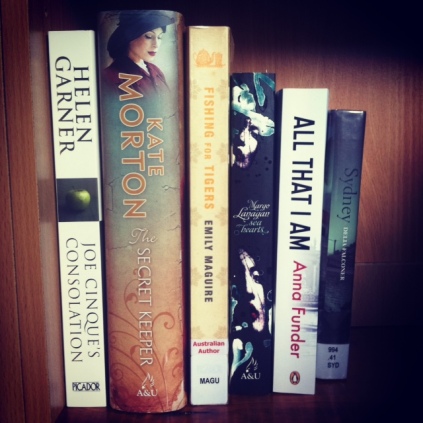
  • Sea Hearts, by Margo Lanagan – there have been some fabulous reviews on this book, especially Elizabeth Lhuede’s review and want to experience this book for myself
  • Fishing for Tigers by Emily Maguire – loved blogging buddy Liv White’s review and interested in the Vietnam setting
  • Sydney by Delia Falconer – this book is physically exquisite and about my home town; I loved Delia Falconer’s ‘Service of Clouds’ and her celebration of the Blue Mountains in that novel so I am sure ‘Sydney’ will also celebrate its heart
  • Joe Cinque’s Consolation – Helen Garner – because I love Helen Garner’s hard-hitting analysis in her non-fiction works and I haven’t read this one
  • The Secret Keeper – Kate Morton – loved her previous books and Kate is enjoying high praise including as top voted Australian writer in a recent booktopia poll.

Well, that’s my six books, for now anyway – I am sure many more will vie for my attention this year. It’s such a rich field of pleasure, the work of our Australian women writers, so let’s celebrate and document it.

A special thanks to Elizabeth Lhuede for initiating the challenge in 2012 and maintaining the hard work of holding it all together for the benefit of us all.

I hope you’ll join the challenge!

My #AWW2013 reads lined up and ready to go!

My #AWW2013 reads lined up and ready to go!

creativity introversion writing

Making space to speak

July 29, 2012

The balance between partnerships and creativity, between being together and being alone, between doing/being and reflecting on the doing and being, is often a fine line. Like many people, I have sought to manage and maintain the balance. It is often easier to create when you have space and solitude; but relationships, family, work and friends are all so important.

Tillie Olsen’s, ‘Silences‘ published in 1978, is about the conditions for creating art, and the circumstances that inhibit and foster the development of writing and other art forms. She examines what works for creativity; the circumstances that she analyses include gender, race and economic situation. A product of its time, ‘Silences’ identifies the high number of women, for example, who have not married or had children and created works of art. Certainly the personal and social situations we create, choose and find ourselves in are an influence in what we create and the conditions in which it is created.

I wrote about this some time ago in a poem that still holds true for me about the balance between relationships and creativity:

Half a Man

If I had even half a man now
could I write the night,
out into its waiting wings
to penetrate delight.

If I had a part of one
who tried to gather all,
I’d run because his promise
is not wiser than the call.

If I had a whole man
who could teach me to receive,
I’d write between the space he gave
and love with sudden ease.

Sometimes , the space itself, when we do find it, can be almost too much, overwhelming in its vacancy to fill. The feeling of all that open space in which to create, once we have organised it or when it is just there due to circumstance, can in itself be intimidating as May Sarton writes in ‘Journal of a Solitude‘:

The ambience here is order and beauty. That is what frightens me when I am first alone again. I feel inadequate. I have made an open place, a place for meditation. What if I cannot find myself inside it? (p12)

I love the approach of Australian writer, Kate Grenville, to capturing every inspiration and opportunity to create. As she documents in ‘Searching for the Secret River‘, Kate uses a series of mantras to keep herself writing: ‘never have a blank page,’ ‘don’t wait for the mood’, ‘fix it up later’ and ‘don’t wait for time to write’. She further writes:

I learned to work in whatever slivers of time the day might give me – one of my favourite scenes in ‘Joan Makes History‘ was written in the car waiting to pick up Tom from a birthday party, on the only paper I could find, the inside of a flattened Panadol packet. I had slivers of time, so I wrote in slivers of words: a page here, a paragraph there. Eventually the slivers would add to something. (p145)

So it seems there is no perfect formula for making space to speak. Whilst some conditions might make writing and other creativity more likely, if we are serious about it, we need to write and create in whatever situation we find ourselves. It’s possibly also that waiting for the perfect conditions is just another form of resistance to getting down to work.

That’s why this blog is so important to me; it’s a stay against silence, a way of creating space to speak, a way of practising making space, so that my writing here now (nearly) each week is an achievement, a making of space in an otherwise very busy life.

So with all this in mind, what habitat suits you to create? What conditions help you write or create art? What have you learnt from your experiences in creativity over time ?

PRIVACY POLICY

Privacy Policy

COOKIE POLICY

Cookie Policy