Category

reading notes

reading notes

Reading Notes for Book Voyeurs #2

September 19, 2010

An occasional series on what I’m reading and why…

Paul Bowles, ‘The Sheltering Sky’, 1949 Penguin (Republished, 2009 with introduction by Paul Theroux)
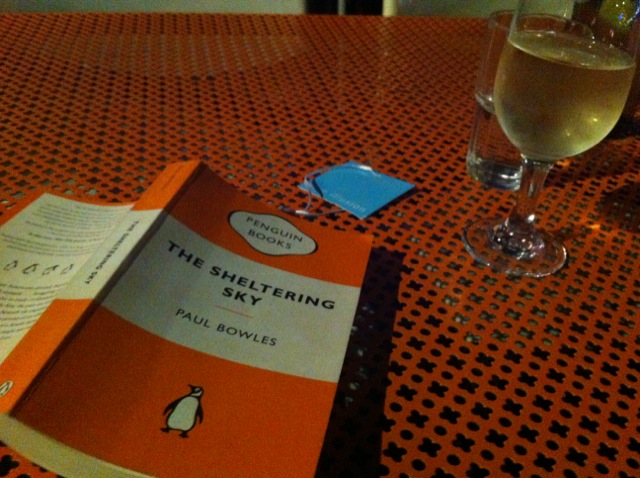
I talked about the book voyeur phenomenon here. I’m always interested in the randomness and reasons around what others are reading, carrying around with them to read and also now reading on the kindle and internet. I contribute my reading experiences here in this same spirit.

I love a classic, especially one that may not be right out there and that has in any case bypassed me. Paul Bowles’ ‘The Sheltering Sky’ has been such a discovery. It’s the first book of his I have read and I look forward to reading his other writing now. The edition I have is one of the republished Penguin classics; available here in Australia for $9.95 and with a new introduction by Paul Theroux. I loved the introduction, but wisely left it to read till after ‘The Sheltering Sky’ itself as it tells you what happens.

I haven’t come across Paul Bowles in my literature travels and reading journey and I wonder why he has escaped me. His style is dark and hypnotic; beautiful prose describing horrific scenes that repulse and attract you at once. It’s like watching a train wreck, but a compelling and stylish one.

My reading experience was interrupted. Too much reading of blogs and a lot of work in the day job meant ‘The Sheltering Sky’ didn’t get read as well as it deserved; at least for half of it, it was piecemeal and interrupted. Ironically, some time away for work delivered some excellent uninterrupted reading time en route and over dinner at night on my own. Then, finally, I lost myself in the second half of the book and surrendered to its prose and unrelenting entropy. As soon as I finished, I wanted to read it again.

It’s not a happy story; I won’t tell you everything that happens. Husband and wife, Port and Kit Moresby travel to the Northern Africa and into the Sahara to escape something: their marriage, themselves, boredom, society. You wonder why they are making this journey. The landscape and people are haunting and alien, hostile and threatening, and Port and Kit, along with their acquired companion, Tunner, make the journey deeper and deeper. It’s exotic and spell-binding even as you want them to turn back and you also turn away.

As Theroux concludes in the introduction:

…it is obvious that he wanted to give the desert a face and a mood – or moods; he often depicts a landscape in anatomical terms, and he could only do that by describing people somewhat like ourselves crawling around it and becoming its victims.

I loved the quote accompanying Book One ‘Tea in the Sahara’:

Each man’s journey is personal only insofar as it may resemble what is already in his memory. Eduardo Mallea

The book has that same unobtainable quality, like a maze of mirrors or a mirage; hard to pin down and unsure of its destination. Theroux describes the novel as ‘strange, uneven and somewhat hallucinatory…’  A journey, a process, but one full of breath-taking prose, the sheltering sky of the title woven through-out as a recurring image in different forms. Tennessee Williams’ 1949 review in the New York Times, ‘An Allegory of Man and his Sahara’  talks of the layers and depth experienced as a reader:

There is a curiously double level to this novel. The surface is enthralling as narrative. It is impressive as writing. But above that surface is the aura that I spoke of, intangible and powerful, bringing to mind one of those clouds that you have seen in summer, close to the horizon and dark in color and now and then silently pulsing with interior flashes of fire. And that is the surface of the novel that has filled me with such excitement.

I am chasing up the Bertolucci movie of the book which I’m sure is equally hypnotic. I’ll also be chasing up more of Paul Bowles’ books to indulge myself in his beautiful, dark, spare and eloquent prose. And I’ll be reading the work of his wife, Jane Bowles, who I have not had the pleasure of reading yet. If you haven’t experienced the strange pleasure of ‘The Sheltering Sky,’ do surrender to its allure.

I have learnt more about Paul Bowles and his wife Jane Bowles through the following excellent article:

The Forces Within: The Millicent Dillon Interview on Jane Bowles Part 1 on A Victoria Mixon’s Editor’s blog

There are other resources and background here:

The Authorised Paul Bowles website – extensive links and resources including many reviews

The Sheltering Sky – wikipedia Fascinating to see how ‘The Sheltering Sky’ has emerged in so many modern songs and lyrics

Share

family history reading notes

Reading Notes for Book Voyeurs #1

August 16, 2010

An occasional series on what I’m reading and why…

The Journal of Fletcher Christian, Together with the history of Henry Corkhill, Peter Corris, Vintage, 2005

I am an avid reader and read widely. I’m interested in what other people are reading and why they are reading it. I love photos of bookshelves and strain, often sideways, to see what titles are there and how they connect with my own interests and bookshelves. I very much connected with David Barnett’s thoughts in the Guardian:

‘I think it was Sarah Crown who first set me off. “Is it just me?” she asked (while accepting the cliche of that opening phrase), “is it just me, or are the contents of other people’s bookshelves/bedside tables/desks/whatever ALWAYS more interesting than your own?”

Well, is it just me, or … look, does anyone else have an unhealthy obsession not just with what people have on their bookshelves but what they’re actually reading right there and then? Does anyone else stare unashamedly at the paperback that is tucked under someone’s arm while they sort through their purse for change in the queue at Boots? Does anyone else have a better memory for the novel poking out of a new acquaintance’s pocket than that person’s face or name?’

That’s me: a ‘book voyeur’ apparently according to the article. Hopefully others out there have the same fascination with what other people are reading and why. In this spirit, I begin this series with my recent reading of Australian author, Peter Corris’ work, ‘The Journal of Fletcher Christian, Together with the journal of Henry Corkhill.’

Why am I reading this book?

Because I am interested in the genre of historical fiction and especially the place where fact and fiction come together. I am planning a novel based on the facts of the life of my great, great, great-grandmother. There will be some facts but much invention and creation based on intuition and research about times and contexts. I am interested in this nexus and keen to read in the genre I will be writing in. I also wish to understand what a sea voyage and journey to a new life was like at that time.

What was my reading experience like?

The Journal is based around the extended conceit of Corris, a historian and fiction writer, receiving a parcel in the mail with two journals enclosed, one being the journal of Henry Corkhill and the other being the journal of Fletcher Christian. Christian is well known as the mutineer of ‘Mutiny on the Bounty’ fame and the journal is the possible story of what really happened in the events leading up to the mutiny and the eventual beginning of the Pitcairn Island community.

I have to admit I was confused while I read about what was real and what was fiction.  The account of receiving the two journals is in the introduction to the book, a place where I would expect some truth from the author. But it seems that this is part of the conceit and the book is fiction. It was in the fiction section of my library, so this was a clue… Finally, I read this interview with Peter Corris which explains that it all was an elaborate conceit – a story within a story. Corris does have a distant family connection but the journals are fictional creations based on this link. I felt more comfortable once I understood this and it does work well as a literary device, if an unclear one for this reader at first.

I loved the writing, the era it evoked, the events and the characters’ psyches it unpacked, especially the clashing wills and personalities of Christian and Bligh. Being a historian as well as a novelist, Corris has created a world that is real and detailed, with the vernacular well captured. I especially loved the voice of the characters captured in the journals themselves. The journal of Henry Corkhill is equally engaging, a different voice to Christian’s and particularly eloquent and surprisingly tender in his accounts of his sexual experiences.

At other times, I found the misogyny difficult to read and hard to stomach, but I understand it was part of the times, with women being currency in the exchanges of men around land and rights. These are times that I will need to write about also and need to understand the dynamics of but the extent and ‘reality’ of it hit me very hard.

I was interested in the book because it was about sea voyages and ship life in the time my ancestor sailed to Australia. I was transported also to another time, another paradigm, to a story about two men who both seem unstable and mad but held the lives of so many in their hands. The interplay between them is compelling and a fascinating psychological insight into what might have happened and why.

I recommend it for anyone interested in the story of the Mutiny on the Bounty which I know has its own fascination and followers,  and for anyone interested in historical fiction, journals, family history, sea  journeys and the interplay between fact and fiction.

Other related reading:

Making true fiction – Shanna Germain

The lying art of historical fiction – James Forrester (Guardian)

Other reading blogs I enjoy:

Girls Just Reading

Bibliophile by the Sea

More about what others are reading:

The Book Depository Map: a boon for book voyeurs – David Barnett (Guardian)

Please send me any other links and leads in the book voyeur genre!

Image, 317/366 The Bountyby Magic Madzik from flickr and used under a Creative Commons license with thanks

Share

reading notes writing

Gems #1 Reading notes

May 29, 2010

Some gems shining a little light this week:

Via the communicatrix, news of a new online magazine for women called Delish. Focusing on ‘what’s real, what’s useful and what’s beautiful’, it is gorgeous, smart, savvy and multi-faceted and clearly will appeal to an audience with these same qualities. Congrats to the team – it’s sensational.

I laughed out loud this week reading the quirky hyperbole and a half and a great post on sneaky hate spirals – all about days when all the little annoyances just build up.

And a true vintage gem I love – Marion Milner’s ‘A Life Of One’s Own’ , published in 1934 under the pseudonym Joanna Field. A pioneering exploration based on her own diaries, the book is the record of a seven years’ study of living and identifying what makes her happy. From this, she provides  perceptions and suggestions that can be practised to increase focus and happiness. It concludes with a discovery about psychic bisexuality – balancing the best of both worlds from what Marion sees as our male and female orientations: the objective and the intuitive respectively. Some words from this beautifully reflective book:

My daydreams are nearly all of country cottages, of little gardens, of ‘settling down’ with flowers in vases and coloured curtains. I don’t think of backaches, dish washing.

I want to live amongst things that grow, not amongst machines. To live in a regular rhythm with sun and rain and wind and fresh air and the coming and going of the seasons. I want a few friends that I may learn to know and understand and talk to without embarrassment or doubt.

I want to write books, to see them printed and bound.

And to get clearer ideas on this great tangle of human behaviour.

To simplify my environment so that a vacillating will is kept in the ways that I love. Instead of pulled this way and that in response to the suggestion of the crowd and the line of least resistance.”

Image, Gems XII by fdecomite via Flickr, used under a Creative Commons license

Share

PRIVACY POLICY

Privacy Policy

COOKIE POLICY

Cookie Policy